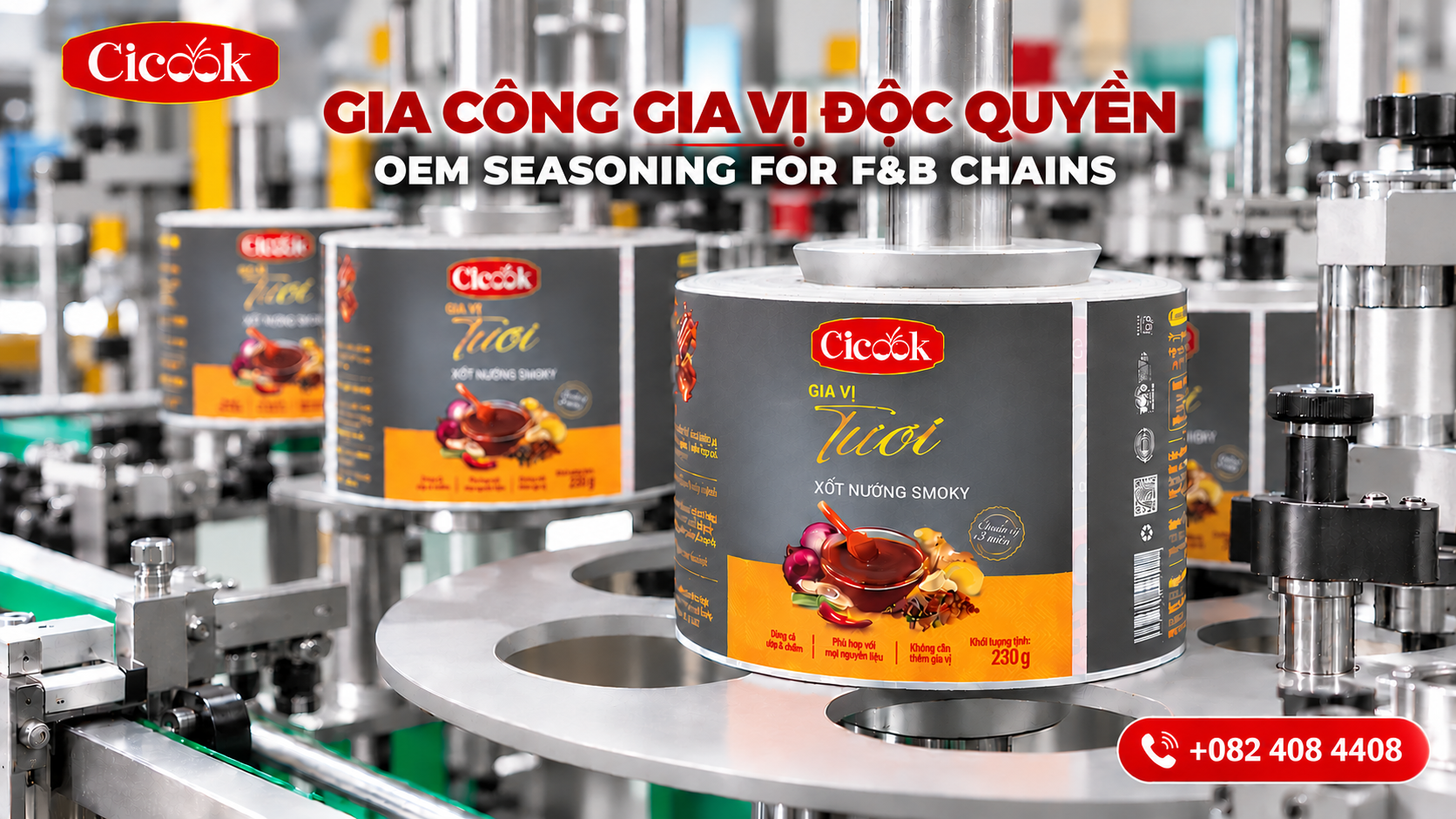
Exclusive Marinade and Broth Manufacturing Solutions for Restaurant Chains: Preserve Your Heritage Recipes, Eliminate Flavor Inconsistencies, and Optimize Food Cost Control with Precise Portioning
Exclusive seasoning manufacturing for F&B chains is a solution that transfers the preparation and blending of signature marinade sauces and soup bases from restaurant kitchens to standardized industrial production lines. By partnering with a manufacturer offering customized seasoning production services, F&B chains can effectively address flavor inconsistency, protect trade secrets, and optimize food costs.
1. Operational Model Comparison: In-House Preparation at Each Branch vs. Exclusive Industrial Manufacturing
| Comparison Criteria | In-House Preparation at Each Branch | Building an Internal Central Kitchen | Exclusive Manufacturing Partnership with CiCook |
|---|---|---|---|
| Flavor Consistency | Low (depends on the cook's skills and mood) | High (if shifts are properly controlled) | Up to 100% consistency through agitator technology and digital sensors |
| Formula Leakage Risk | Very high (kitchen assistants may learn the ingredient ratios) | Moderate (internal employees have access to formulas) | Minimized through legally binding NDAs and restricted production access |
| Initial Capital Investment (CapEx) | Low, but fragmented operations can lead to waste | Very high (VND 2–5 billion for equipment and facility rental) | VND 0 in initial facility investment; costs become variable expenses for each production batch |
| Food Cost Control | High variance due to waste and estimated measurements | Relatively controlled | Precise, gram-level portioning through pre-measured sachets |
| Dish Preparation Time | 15–30 minutes for on-site preparation | 5–10 minutes | 1–3 minutes (open the pre-portioned pack and use immediately) |
| Scalability | Slow (kitchen staff must be retrained whenever a new branch opens) | Limited by facility space and production capacity | Rapid expansion, supporting growth from 5 to more than 50 branches |
2. Three Critical Challenges Facing F&B Chains That Exclusive Manufacturing Can Solve
Challenge 1: Flavor Inconsistency When Scaling Up
When a restaurant grows from one to three locations, the owner may still be able to personally inspect the quality of the sauce prepared each morning. However, once the business reaches 5, 10, or 30 branches—or begins franchising—flavor inconsistency becomes increasingly difficult to avoid.
-
Saltiness and sweetness fluctuate because each location uses different batches of agricultural seasoning ingredients.
-
Branch chefs season dishes according to personal habits rather than using electronic scales and standardized measurements.
CiCook's solution: Recipes are digitized and produced in large-capacity, heated mixing tanks. Key parameters, including sweetness (Brix), saltiness, acidity (pH), and viscosity, are measured using laboratory-standard equipment before packaging. This helps ensure that branches in Hanoi and Ho Chi Minh City deliver the same signature flavor.
F&B chains that already own a standardized recipe may also consider the OEM marinade sauce manufacturing model.
Challenge 2: Dependence on Head Chefs and the Risk of Losing Trade Secrets
One of the biggest concerns for F&B chain founders is the possibility of a head chef resigning and taking the entire recipe to a competitor or opening a competing restaurant.
Exclusive manufacturing moves the entire blending process outside the direct reach of restaurant employees.
-
Products are delivered to branches as fully blended sauce pouches or seasoning powder packs. Employees simply open the package and pour it directly into a hotpot or use it to marinate meat.
-
Exclusive manufacturing agreements with CiCook are governed by strict Non-Disclosure Agreements (NDAs), helping protect the brand's intangible assets and proprietary know-how.
Challenge 3: Optimizing Floor Space and Shortening Store Payback Periods
F&B rental costs in major cities can account for 15%–25% of revenue.
If a restaurant must allocate 30% of its floor space to ingredient preparation, soup base cooking, and bulky seasoning storage, operating costs can increase significantly.
Eliminating on-site sauce preparation helps reduce kitchen space requirements, free up more room for customer seating in the Front of House (FOH) area, and reduce the need for one to two kitchen assistants per shift.
3. Packaging Formats Optimized for Different F&B Operating Models
CiCook flexibly designs packaging solutions to align with each chain's Standard Operating Procedures (SOPs).
Single-Serve Sachets (30g–150g)
-
Applications: Marinade sachets for individual grilled meat portions, single-serving hotpot base packs, and noodle dressing sauce packs.
-
Advantages: Employees do not need to weigh or measure ingredients. One serving of grilled meat uses exactly one sachet, eliminating portioning errors and helping maintain consistent ingredient usage.
Retort Pouches / Industrial Cans (1kg–5kg–10L)
-
Applications: Pho soup bases, buffet-station dipping sauces, and base sauces for large-scale stir-frying and cooking.
-
Advantages: Reduce packaging costs, offer convenient dispensing options, and simplify storage in refrigerated facilities or at ambient temperature, depending on the product and its preservation requirements.
4. CiCook Thu Duc Facility: Supporting F&B Chains as They Grow
CiCook's manufacturing facility, located at 1129 Nguyen Xien Street, Thu Duc City, Ho Chi Minh City, serves as a strategic supply chain partner for food service chains.
Upgrading Kitchen Recipes for Industrial Production
CiCook does more than simply receive a recipe and produce it. Its R&D team helps evaluate and optimize sauce characteristics, including adhesion to meat, heat resistance during grilling to prevent excessive charring, and resistance to sedimentation. These adjustments help dishes maintain their most appealing appearance and quality.
Food Safety Certifications for Export-Oriented Production
The production line operates according to HACCP and ISO 22000 standards, helping F&B chains prepare for food safety inspections conducted by relevant government authorities.
Just-In-Time (JIT) Supply Model
The facility's location in Thu Duc enables efficient distribution to central warehouses (hubs) or scheduled weekly deliveries to branches within the city. This helps restaurants avoid excessive inventory accumulation and reduces the amount of working capital tied up in stock.
Frequently Asked Questions (FAQ)
1. Should a restaurant chain with only 2–3 branches already outsource exclusive seasoning manufacturing?
Yes, especially if you plan to expand the chain or launch a franchise within the next 6–12 months. Standardizing seasonings early allows you to verify flavor consistency and establish a complete set of Standard Operating Procedures (SOPs) before rapidly increasing the number of outlets.
2. How long is the shelf life of industrially manufactured sauces without compromising product quality?
With controlled thermal processing and multilayer aluminum-foil packaging, CiCook's seasoning sauces may achieve a shelf life of 6–12 months at ambient temperature, or 3–6 months for certain fresh, low-acid sauce products, without relying on harmful preservatives.
Actual shelf life depends on the product formulation, pH, water activity, processing conditions, packaging integrity, and validated storage requirements.
3. What if I want to keep a distinctive herb ingredient in my recipe confidential?
CiCook supports a two-stage blending approach. The chain can supply its own finely ground Core Pre-mix, containing the proprietary seasoning ingredients, while CiCook handles the industrial sauce base and homogenization under controlled temperature conditions. This arrangement helps the brand retain control over its core formula.
Expert Perspective & Practical Insights
A candid perspective on scaling restaurant chains: Many F&B chains struggle to expand beyond their third branch not necessarily because of ineffective marketing or poor location choices, but because food quality at new outlets no longer matches that of the original restaurant. Customers may stop returning after experiencing an overly salty marinade or a bland hotpot broth prepared by a new kitchen assistant who estimates ingredient quantities by eye.
In the modern F&B industry, standardization is a core competitive advantage. Do not turn your restaurant into a business that depends on a chef's individual skills every day. Industrialize your seasoning supply and preparation processes so your restaurant can focus on two priorities: optimizing the customer dining experience and increasing revenue.