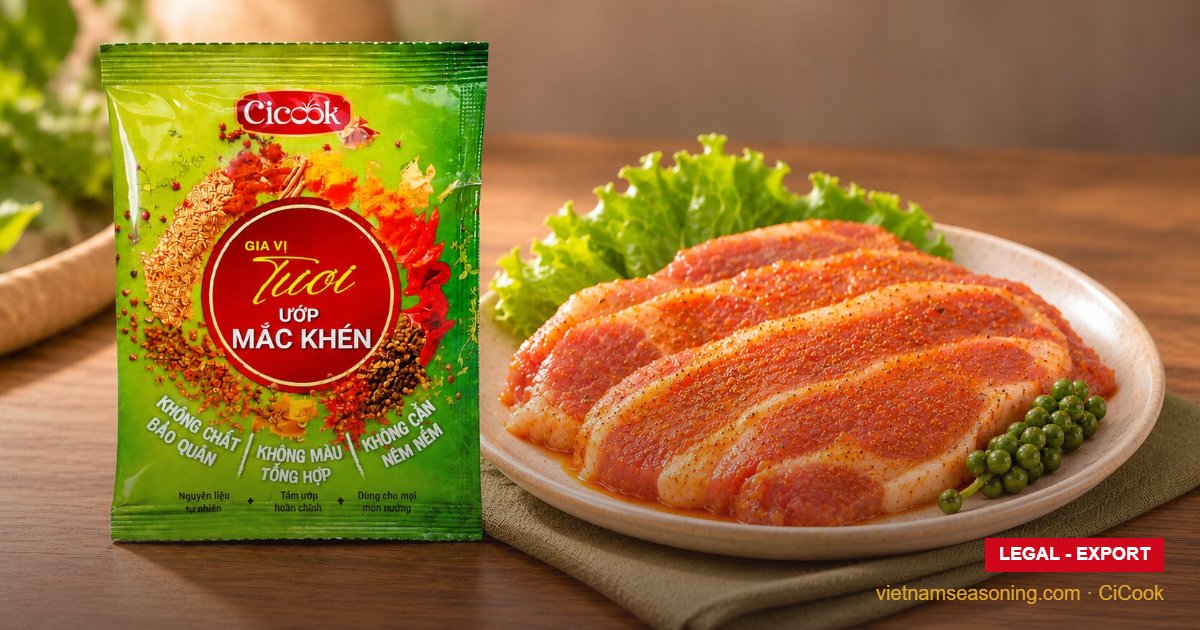
China keeps two separate GACC records for imported food: one for the factory, one for the exporter or agent. Both rules changed in 2026.
Food shipped to China must clear two GACC checks: the factory must be registered under Decree No. 280, and the overseas exporter or agent must hold a filing code under Announcement No. 150 of 2026, issued on 23 October 2026. Seasoning powder is on Decree 280's recommendation list.
Packing cans of sauce into cartons (AI-generated illustration)
1. What did China's customs authority change in October 2026?
China's General Administration of Customs (GACC) revised the rules for filing food exporters and importers. Announcement No. 150 of 2026, dated 23 October 2026, takes effect on publication and replaces Annex 1 of the former AQSIQ Announcement No. 55 of 2012.
The rules cover every overseas exporter or agent that sends food to China, as well as Chinese food importers. Overseas exporters or agents apply to GACC with a standard information form and are responsible for the accuracy of what they declare. Vietnam's National SPS Office, quoted by Viet Nam News on 6 November 2026, said the form has been cut from 20 to 10 fields and that applications can be filed through China's International Trade Single Window or the customs portal at credit.customs.gov.cn.
- Speed: a complete application is filed within 3 working days; if documents are missing, customs must say so once, within 3 working days.
- Filing code: approved overseas exporters or agents receive a filing code, and the record is published on China Customs' enterprise credit information platform.
- Validity: the filing is valid long-term, but any change must be updated within 60 days.
- Declarations: at import, the declaration must show the exporter's or agent's filing code and the importer's unified social credit code, and customs verifies them.
- Checks: according to the SPS Office, customs can inspect on site and cross-check data at the border, and false or inconsistent information can lead to correction orders or cancellation.
The stakes are high for Vietnam: China took 24.4% of the country's agro-forestry-fishery export value in the first nine months of 2026, the largest share of any market, Viet Nam News reported.
2. Factory registration vs exporter filing: what is the difference?
They are two separate records, and a shipment needs both to line up. Decree No. 280 registers the manufacturer; Announcement No. 150 files the trading party that sells to China. A Vietnamese factory that exports through a trading company, or a buyer that uses an agent, has to match the right code to the right company.
| Point | Factory registration (Decree No. 280) | Exporter/agent filing (Announcement No. 150/2026) |
|---|---|---|
| Who registers | Overseas food manufacturer (directly or via an authorised agent) | Overseas exporter or agent selling food to China |
| In force | 1 June 2026 (replaced Decree No. 248) | 23 October 2026 (replaced the 2012 rules) |
| Official channel | CIFER system (cifer.singlewindow.cn), no fee | International Trade Single Window or China Customs online services |
| Processing | Audit and recommendation by the exporting country's competent authority for 17 listed categories | 3 working days for a complete file |
| Validity | 5 years, renewed automatically in most cases | Long-term; changes updated within 60 days |
| Can be lost when | One of 9 revocation grounds applies (up from 7) | Company dissolved, licence revoked, own request, or customs record cancelled |
Sources: GACC Announcement No. 150 of 2026 (full text via China Food Safety News, 24/10/2026); Singapore Food Agency trade circular (28/07/2026).
2.1 Is seasoning powder on China's registration list?
Yes. Decree No. 280 replaced the old list of 18 categories needing a competent-authority recommendation with 17 categories, and "seasoning powder" is one of them, alongside dehydrated vegetables, nuts and seeds, and edible oils. For these products the factory must be audited by the competent authority, and the audit report and recommendation letter go with the application. For liquid sauces outside the list, the circular does not set out the procedure, so confirm the requirement for your exact HS code in CIFER before quoting.
3. What can go wrong for Vietnamese sauce exporters?
Most problems are mismatches, not refusals. Because customs now verifies the filing code on every declaration, the following situations deserve attention:
- Changed company details. A new address, name or legal representative must be updated within 60 days, or the declared data will not match the record.
- Trading-company shipments. When the seller is a trader rather than the factory, both the trader's filing code and the factory's registration must be valid.
- Revocation risk. Decree No. 280 lists nine grounds for revoking a factory registration, including serious food safety problems found at the Chinese border and lending or misusing the registration number.
- Unofficial "agents". SFA notes that CIFER is the only official channel for factory registration and charges no fee.
4. How should buyers check a supplier before shipping to China?
Ask for proof of both records and compare them with the commercial documents. A vendor-neutral checklist:
- Get the factory's GACC registration number and confirm the product category it covers matches your product.
- Get the exporter's or agent's filing code and check that the name matches the invoice and contract exactly.
- Check renewal dates. Factory registrations last five years; meat and bird's nest products are not renewed automatically.
- Agree who updates records after any change of company details, within the 60-day window.
- Keep batch documents ready. A COA per lot and the usual export papers still apply; see our guide to export documents buyers should request for Vietnamese sauces.
The same habit of checking at the source applies to every certificate a supplier sends; our guide on how to verify a sauce supplier's certificates covers FDA and ISO 22000 records.
5. What this means for importers and brands
For brands planning China, registration status belongs on the supplier checklist before samples, especially for powdered products such as Vietnamese dry rubs and seasoning powders. CiCook, an FDA-registered, ISO 22000:2018 and HACCP-certified manufacturer, issues a COA for every batch and can discuss market requirements product by product.
FAQ
How long does GACC take to file an overseas food exporter?
Under Announcement No. 150 of 2026, customs files a complete application within 3 working days. If something is missing, it must tell the applicant once, also within 3 working days.
Does a factory registration under Decree No. 280 expire?
It is valid for five years and is renewed automatically, except for meat and bird's nest products, factories under rectification, or countries whose imports GACC has suspended.
Planning sauce or seasoning shipments to China? Contact CiCook or message WhatsApp +84 813 378 398.
References
- GACC via China Food Safety News (24/10/2026): Announcement No. 150 of 2026 on rules for filing food exporters and importers (Chinese)
- Singapore Food Agency (28/07/2026): Update on China's revised registration requirements for overseas food manufacturers – GACC Decree No. 280
- Viet Nam News (6/11/2026): Food exporters urged to enhance food safety, traceability to meet China's new rules
- Cong Thuong (02/11/2026): China revises food exporter registration rules (Vietnamese)