What kosher certification checks in a sauce, which OU symbols to expect, and why fish sauce and shrimp paste are treated differently.
Kosher certification for a sauce means a rabbinic agency has approved every ingredient, the production line and the label. For Vietnamese sauces the key questions are fish: fish sauce needs kosher fish and a fish marking, while shrimp or other shellfish ingredients cannot be certified kosher.
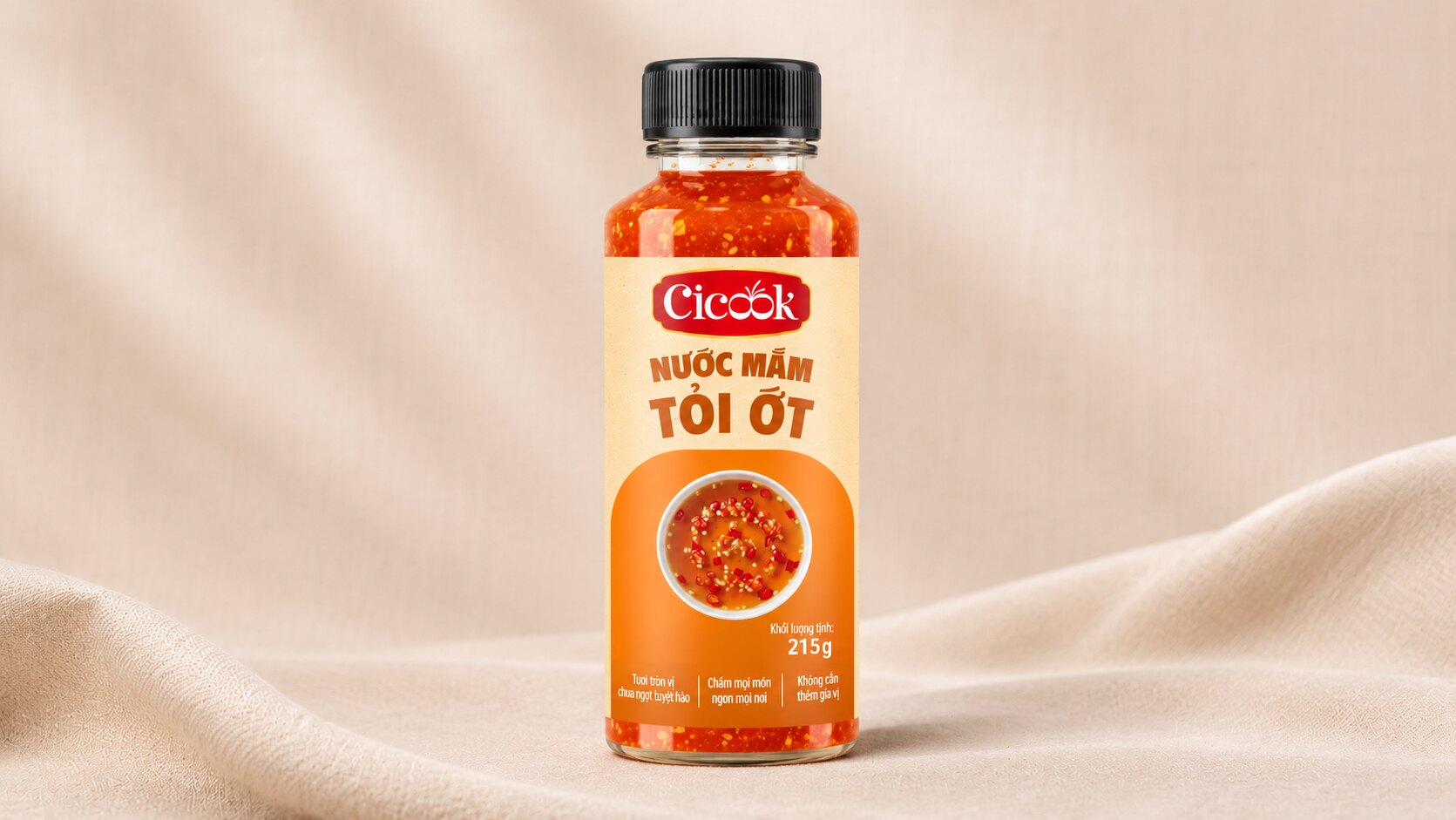
A bottle of garlic chili fish sauce dip on a cream fabric background. (Illustrative photo)
1. What does kosher certification cover for a sauce?
It covers three things: the ingredients, the facility and the way the product is made. OU Kosher, a leading US certifying agency, describes certification as a rabbinic agency checking all three before the product may carry its symbol. A sauce can fail on a single minor input, such as an animal-derived glycerin, a flavouring or a shared hot production line.
Kosher rules exclude certain animals and fish; OU Kosher notes that the biblical list of non-kosher foods includes "any shellfish". Meat and dairy may not be produced or eaten together, and equipment that has run non-kosher hot production needs a cleaning process called kosherization before it can make certified product.
1.1 Can Vietnamese fish sauce be kosher?
It can, if the fish and the process qualify. OU Kosher states that a kosher fish must have both fins and scales, and that processed fish products need certification because preparation, equipment or contact with other fish can make them non-kosher. In practice this means the agency has to be satisfied about the species in the catch, not only the finished liquid.
Sauces built on shrimp, shrimp paste or other shellfish are a different case: because shellfish is not kosher, these products cannot carry a kosher symbol, whatever the rest of the formula.
2. Which kosher symbols will buyers see on sauce labels?
The letter after the agency's mark tells the buyer how the sauce may be used. The table below uses OU Kosher's own definitions; other agencies use similar but not identical systems.
| Symbol (OU) | Meaning given by OU Kosher | What it means for a sauce buyer |
|---|---|---|
| OU (plain) | Pareve: no meat or dairy ingredients and not made on meat or dairy equipment; not automatically kosher for Passover | Widest use; OU notes a pareve product may still contain fish or eggs |
| OU-D | Contains a dairy ingredient or was made on dairy equipment | Not for use with meat dishes; relevant for creamy or cheese-based sauces |
| OU-DE | Made on dairy equipment | Signals shared equipment rather than a dairy ingredient |
| OU-Meat | Contains a meat ingredient or was made on meat equipment | Applies to broth-based bases or marinades with meat extracts |
| OU-F | Contains fish ingredients; not to be eaten or cooked with meat | The usual marking for fish sauce and fish-based dips |
| OU-P | Kosher for Passover and pareve | Needs a separate Passover review of the formula |
Source: OU Kosher, "OU Kosher Symbols Explained" (updated 5 March 2024) and "Kosher Fish".
2.1 What if fish is only a minor ingredient?
The ratio decides the marking. According to OU Kosher, when the fish ingredient is less than one part in sixty of the product, no "F" is added; at a higher share, the product is labelled OU-F. The Council of Orthodox Rabbis of Greater Detroit gives Worcestershire sauce as an example: versions with more than 1/60 anchovy carry the word "FISH" next to the kosher symbol and should not be used with meat.
3. How does a sauce maker get kosher certified, and what does it cost?
Through a six-step agency process, with fees set case by case. OU Kosher publishes these steps:
- Application. The company submits a detailed list of ingredients and their suppliers, and a rabbinic coordinator is assigned.
- In-plant consultation. A rabbinic field representative visits the facility.
- Assessment. The agency decides whether it can certify the plant and products.
- Contract. This sets out requirements and fees, including Schedule A (approved ingredients) and Schedule B (products allowed to carry the symbol).
- Label approval. Each label with the symbol is checked before printing.
- Certification. Products are listed in the agency's database, and a local rabbi carries out ongoing inspections for as long as the company stays certified.
On cost, OU Kosher says a processing fee and a travel expense fee are billed before the plant visit, but it does not publish amounts or a standard timeline. Because fees and timing are set for each plant, buyers should ask the agency for a written quote and schedule.
4. What problems do importers run into?
- Hidden ingredients. OU Kosher points to animal glycerin, usually from tallow or lard, as a common reason a product fails; plant-based versions exist. Flavourings, emulsifiers and colourings need the same check.
- Shared lines. According to OU Kosher, agencies will not certify a line that runs kosher and non-kosher products at the same time, although clean-in-place sterilization is usually enough between runs.
- Mixed fish and meat. A fish sauce marinade sold for meat dishes may clash with the OU-F rule that fish products are not eaten with meat, so the use on the label matters.
- Agency recognition. Customers in each market trust different agencies; a symbol accepted by one retailer may not satisfy another.
5. Practical checklist for sourcing kosher sauces
- Ask for the current certificate and Schedule B. Check that the exact product name and pack size are listed, not only the factory.
- Confirm the marking. Make sure fish-based sauces carry the fish designation the agency requires and that your recipes or menus respect it.
- Freeze the formula. Any new ingredient or supplier must be approved by the agency before use, so agree a change-control rule in the contract.
- Keep kosher papers with the rest of the file. Store them alongside the documents buyers should request for Vietnamese sauces, such as the certificate of origin and COA.
- Treat kosher and halal as separate projects. Each has its own agency, rules and audit; our guide to Indonesia's halal rules for imported sauces shows how different the requirements can be.
6. What this means for importers and brands
For buyers of a Vietnamese fish sauce range, kosher is a product-by-product agency approval, so it is best raised at the brief, before formulas and labels are fixed. CiCook produces fish sauce dips, hotpot bases and marinades under HACCP and ISO 22000:2018 with a COA for every batch, and develops OEM, ODM and private-label formulas under NDA.
FAQ
Is kosher certification the same as halal certification?
No. They are issued by different bodies under different religious rules, with separate audits and symbols. A product may hold one, both or neither.
Does a kosher symbol on fish sauce mean it can be used in any dish?
No. OU Kosher says products marked OU-F should not be eaten or cooked with meat, although they may be used with dairy.
Planning a kosher sauce line? Contact CiCook or message WhatsApp +84 813 378 398.
References
- OU Kosher (updated 3 March 2020): What is kosher certification?
- OU Kosher (8 November 2019, updated 5 March 2024): OU kosher symbols explained
- OU Kosher (updated 13 February 2023): Kosher fish
- OU Kosher: Steps for kosher certification
- OU Kosher (24 January 2022): The life and times of an application for OU kosher certification
- OU Kosher (27 February 2025): What food manufacturers need to know about going kosher
- COR of Greater Detroit via KosherQuest: Sauces containing fish