Vietnam's ginger and turmeric shipments jumped 50% in nine months of 2026 while export value slipped. Here is what the data means for buyers.
Vietnam exported 26,525 tonnes of ginger, turmeric and other spices in the first nine months of 2026, up 50.1% year on year, according to the Vietnam Pepper and Spice Association (VPSA). Export value fell 5% to US$45.9 million, so the average value per tonne dropped by about a third.
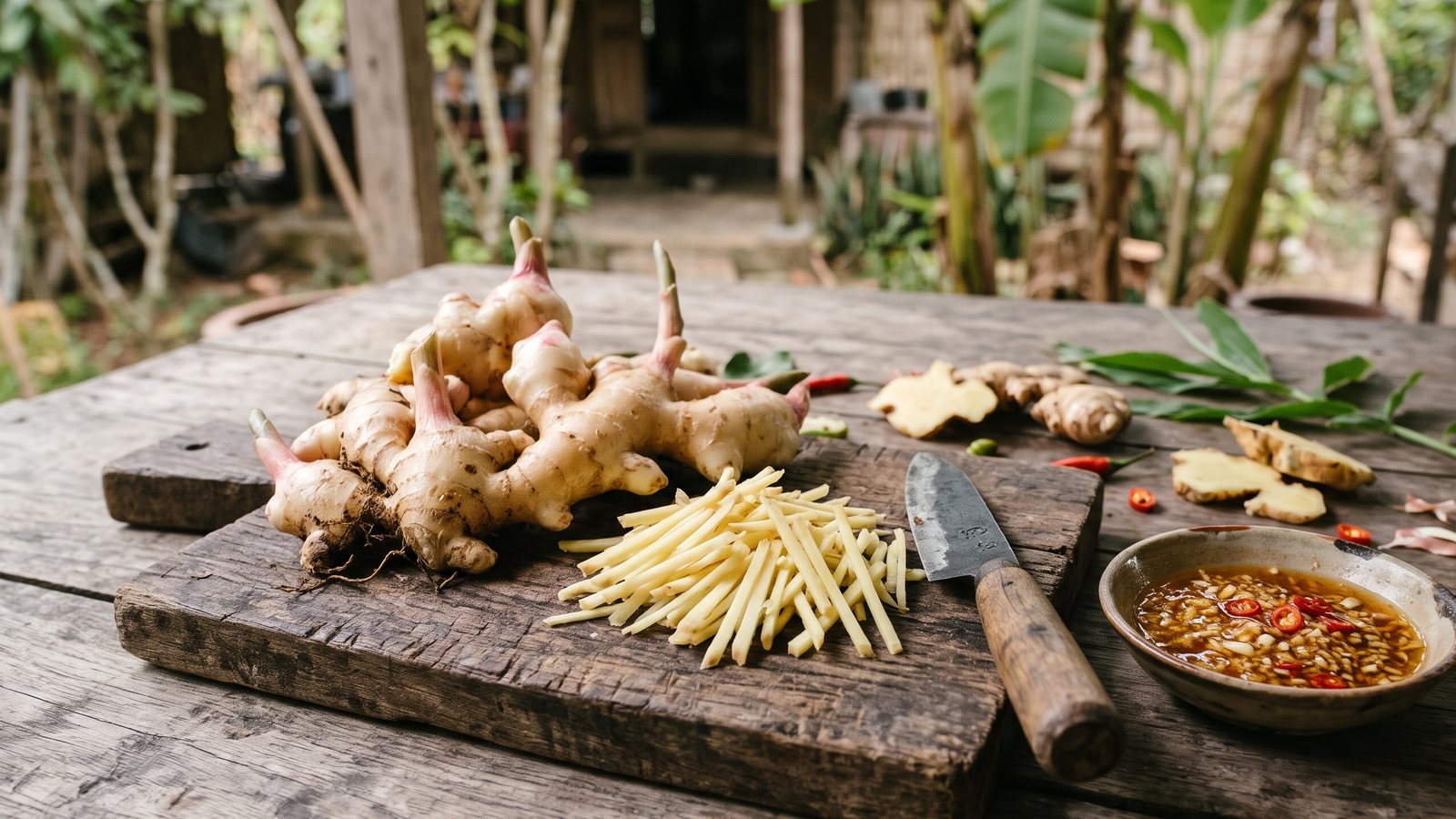
Fresh ginger roots, julienned ginger and a bowl of dipping sauce with sliced chilli on a wooden board (AI-generated illustration)
1. What happened to Vietnam's ginger and turmeric exports in 2026?
Volume rose sharply but revenue did not follow. Preliminary VPSA statistics, reported by Dan Tri on 16 October 2026 and by Thoi bao Ngan hang on 20 October 2026, show 26,525 tonnes of ginger, turmeric and other spices shipped in January–September 2026, worth US$45.9 million.
Thoi bao Ngan hang calculates the average export value at about US$1,730 per tonne, down nearly 36.7% on the same period of 2025. The paper also cautions that this is a group average, not the price of any single spice: changes in product mix, quality grades and destination markets can all pull the figure down.
2. Which markets are buying Vietnamese ginger and turmeric?
Asia takes most of the volume. Asian buyers imported almost 22,000 tonnes, up 69.2%, or about 83% of the total. Three markets alone account for 60.8% of shipments.
| Market / indicator | 9M 2026 | Change vs 9M 2025 |
|---|---|---|
| Total volume (ginger, turmeric, other spices) | 26,525 t | +50.1% |
| Total value | US$45.9 million | -5% |
| Average export value | ~US$1,730/t | about -36.7% |
| India | almost 5,600 t | +21.8% |
| Indonesia | almost 5,600 t | +61.6% |
| Bangladesh | over 5,000 t | more than 25 times (from 195 t) |
| Europe | over 2,400 t | -14.5% (Germany +39.3%, over 1,000 t) |
| United States | almost 1,300 t | n/a |
| Africa | 1.5% of volume | +230% |
Sources: VPSA preliminary data via Dan Tri (16/10/2026) and Thoi bao Ngan hang (20/10/2026).
Bangladesh alone added more than 4,800 tonnes, about 54.3% of the extra volume, Dan Tri reports. Without that one buyer, growth would look far more modest.
2.1 What forms of ginger and turmeric does Vietnam export?
Vietnamese ginger is shipped mainly frozen, alongside processed products for seasoning use, according to Dan Tri. Processors are moving into dried ginger, ginger powder, turmeric powder, turmeric starch and curcumin extract. The Ministry of Agriculture and Environment puts the growing area at about 45,000 ha (Quang Ngai, Nghe An, Lam Dong, Gia Lai), with 2025 output of roughly 120,000 tonnes of ginger and 80,000 tonnes of turmeric. Vietnamese turmeric is reported to contain about 3–5% curcumin.
3. Is the export momentum slowing down?
Yes, quarter by quarter the pace has dropped. VPSA data cited by Dan Tri show about 13,000 tonnes in Q1, just over 9,300 tonnes in Q2 and only about 4,200 tonnes in Q3 2026. The strong nine-month total was built mostly in the first half and in a few Asian markets.
Supply is the other weak point. VPSA chair Hoang Thi Lien told Dan Tri that the lack of large, standard-compliant growing areas keeps spice exports unstable, and that scattered smallholder plots make it hard for buyers to confirm planting area and output for origin paperwork. Europe, the market with the strictest residue and traceability checks, is also the one where volume fell.
4. What should sauce and seasoning buyers check now?
A lower average export value does not automatically mean cheaper ingredients for your recipe. Use these vendor-neutral checks when you source ginger or turmeric, or finished sauces that contain them:
- Compare like with like. Ask for quotes by exact form (frozen, dried slices, powder) and grade; the 36.7% drop is an average across a mixed product group.
- Request batch documents. A certificate of analysis for each lot, plus the health certificate and certificate of origin your market requires; see our guide to export documents for Vietnamese sauces.
- Ask where the raw material comes from. Given the smallholder supply base, ask how the supplier links each batch to its growing area before you rely on it for traceability.
- Specify colour and pungency targets. For turmeric, agree on a curcumin range in the spec sheet rather than "good colour"; for ginger, agree on form and moisture.
- Inspect before loading. Book an independent check for high-volume orders; our pre-shipment inspection guide for sauce imports explains the steps.
5. What this means for importers and brands
For brands, the more useful signal is the shift toward processed ginger and turmeric products, which suits buyers who want ready-to-use seasonings rather than raw roots. CiCook, an FDA-registered, ISO 22000:2018 and HACCP-certified manufacturer that issues a COA for every batch, develops OEM and ODM seasonings such as Vietnamese dry rubs and seasoning powders.
FAQ
Why did the value of Vietnam's ginger and turmeric exports fall while volume rose?
The group's average export value fell about 36.7%. Thoi bao Ngan hang notes this may reflect lower transaction prices, a different product mix or a different market mix; the aggregate data are not enough to pin down one cause.
Who is the biggest buyer of Vietnamese ginger and turmeric?
In January–September 2026, India and Indonesia each took almost 5,600 tonnes and Bangladesh over 5,000 tonnes. Together they accounted for 60.8% of export volume.
Sourcing Vietnamese seasonings? Contact CiCook or message us on WhatsApp/Zalo +84 824 084 408.