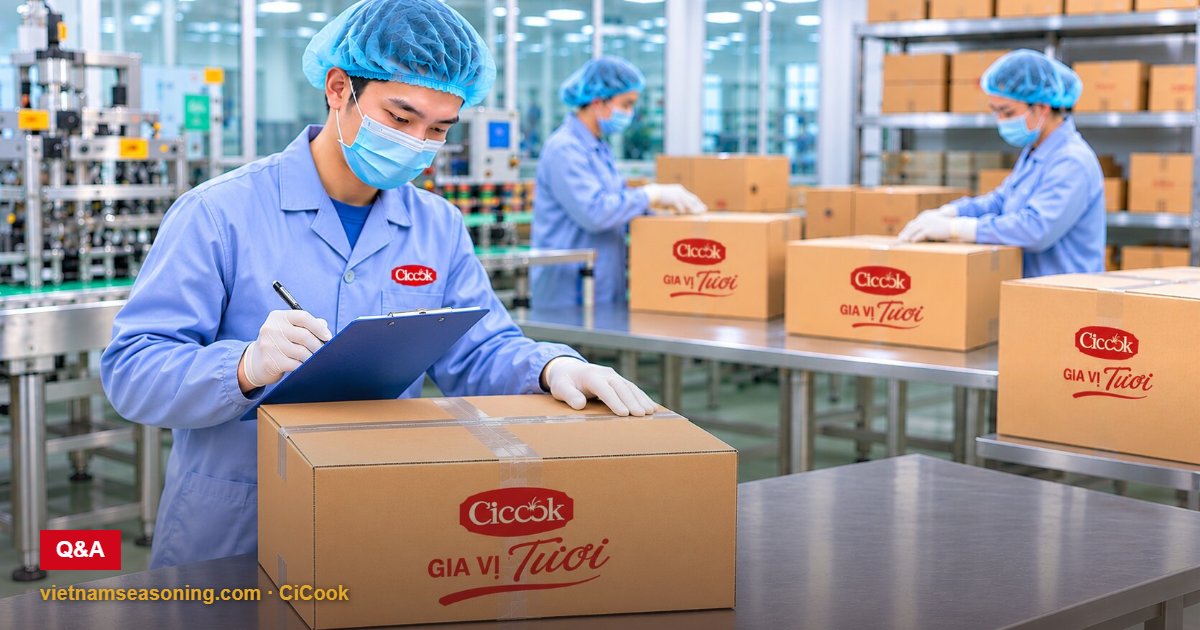
What an independent pre-shipment inspection checks on a Vietnamese sauce order, how sample sizes are set and how it differs from lab tests and FDA checks.
Pre-shipment inspection is an independent check of a sauce order at the factory before the container leaves Vietnam: an inspector samples finished cartons, checks labels, lot codes, seals, quantity and loading against the purchase order, and reports before final payment. It does not replace FDA checks at the US port.
This guide (as of November 2026) answers the questions importers and distributors ask most often when they first book an inspection for bottled, canned or pouched sauces and seasonings from Vietnam: what is checked, how big the sample is, what it costs in time and money, and where its limits are. It builds on our earlier guide to the export documents buyers should request for Vietnamese sauces.
1. What is pre-shipment inspection for sauce imports?
Pre-shipment inspection (PSI) is a check carried out in the exporting country, before goods are shipped, to confirm that what is packed matches what was ordered. The WTO Agreement on Preshipment Inspection describes these activities as verifying the quality, quantity and price of goods, among other things, before they are exported.
One detail matters for food buyers: that WTO agreement governs inspections that a government contracts or mandates. Most sauce importers commission an inspection privately, as a term of their own purchase contract, so the scope, timing and pass/fail rules are whatever buyer and supplier write into that contract. In practice, buyers choose from three formats:
- During-production check: useful for a first order or a new recipe, so label or filling problems are caught while they can still be corrected.
- Final random inspection: done when the order is fully produced and packed, with cartons drawn at random for checking.
- Container loading check: the inspector watches loading, records carton counts and the container seal number, and photographs the closed container.
1.1 What does the inspector check on a sauce order?
A sauce inspection is mostly about packaging, labelling and quantity. A practical checklist covers:
- Product identity, flavour and pack size against the purchase order.
- Label artwork against the approved version: product name, ingredient and allergen statement, net content, importer details and any market-specific wording.
- Lot codes and best-before dates, and whether they match the batch numbers on the COA.
- Pack integrity: cap torque and induction seals on bottles and jars, seams and the absence of bulging or dents on cans, and seal strength on pouches and sachets.
- Carton marks, carton count, pallet build and the condition of the container (clean, dry, no odour).
2. Does pre-shipment inspection replace lab tests or FDA checks?
No. A pre-shipment inspection checks what can be seen and counted; laboratory tests check what cannot; and for the United States, the FDA makes its own admissibility decision when the shipment arrives. The table compares the three.
| Pre-shipment inspection | Laboratory testing (COA or third-party) | FDA entry review (US) | |
|---|---|---|---|
| Who orders it | Usually the buyer, under the sales contract | The manufacturer for its COA; the buyer for any extra tests | FDA, after the entry is filed through CBP |
| When | At the factory, before or during loading | Per batch, before release | At entry into the US |
| What it covers | Labels, lot codes, packaging, quantity, loading | The parameters listed in the product specification | Electronic screening; may add a field exam, label exam or sample collection |
| Result | Inspection report against agreed criteria | Certificate of analysis | Release, request for information, or a Notice of FDA Action; detention if a violation appears |
| Who pays | The party named in the contract | The party that orders the test | FDA pays for physically sampled product found in compliance (21 CFR 1.91), not for product initially found in violation |
Sources: U.S. FDA, Entry Review (updated 21 January 2026) and Examination & Sample Collection (current as of 11 April 2025).
According to the FDA, all electronic entry data for FDA-regulated products is screened, lower-risk entries may be released without further review, and the rest go to human review under the FDA ImportShield Program. A release does not rule out later FDA action. If FDA decides to examine or sample, a Notice of FDA Action tells the importer which lines to hold; if results suggest a violation, a Notice of Detention and Hearing follows. FDA sets no fixed time limit for this process. Traceability records are a separate obligation, explained in our article on whether the FDA Food Traceability Rule covers Vietnamese sauces.

A technician pipettes a sample at a laboratory bench. (AI-generated illustration)
3. How is the sample size decided?
The sample size comes from an acceptance sampling plan that buyer and supplier agree before inspection, most often based on ISO 2859-1, the international standard for sampling by attributes indexed by acceptance quality limit (AQL). ISO lists the 1999 edition as withdrawn and revised by ISO 2859-1:2026, so new contracts should name the current edition.
The plan sets how many units are drawn from the lot and how many defects are allowed before the lot fails. For sauces, it helps to classify defects in advance, for example:
- Critical: leaking or broken seals, bulging cans, a missing or wrong allergen statement. Usually zero tolerance.
- Major: wrong lot code or best-before date, short fill, damaged can seams.
- Minor: scuffed cartons or slightly misaligned labels that do not affect legibility.
Cost and time follow from the format and the sample size: a single-flavour container needs less inspection time than a mixed container with many SKUs. Ask the inspection company to quote per inspection day and to state in advance whether travel and any lab tests are included.
4. What goes wrong on sauce shipments?
Most failed inspections on sauce orders come from a few repeat issues rather than from the recipe itself:
- Artwork drift: a label printed from an earlier draft, especially after late changes to the allergen or importer line.
- Code mismatches: lot codes on the pack that do not match the COA or the packing list, which later complicates any traceability request.
- Late booking: an inspection booked after the container is already scheduled can delay loading. Even for government-mandated PSI, the WTO agreement gives the inspection body up to five working days, after the inspection and receipt of the final documents, to issue a Clean Report of Findings or explain why not.
- Transit damage risk: weak cartons or poor pallet build that pass at the factory but fail after a long voyage.
5. Practical checklist before booking an inspection
- Write the inspection right into the purchase contract: format, sampling standard and edition, defect classes, who pays, and what happens if the lot fails.
- Send the inspector the approved label artwork, the product specification and the packing list in advance.
- Book the final inspection for when production is complete and packed, and keep loading flexible by a day or two.
- Ask for photos of every carton mark, lot code and the container seal, not just a pass/fail result.
- Keep the report with the COA and shipping documents, so they can be produced together if FDA or a customer asks.
6. What this means for importers and brands
Pre-shipment inspection works best when it is planned with shipping: a failed lot found at the factory is far cheaper to fix than one found at the destination port, and freight timing affects when the inspector can attend (see our note on how container freight rates affect sauce importers). CiCook issues a COA for every batch from a facility registered with the US FDA and certified to ISO 22000:2018 with HACCP, so inspection findings can be cross-checked against batch documents.
FAQ
Who should pay for a pre-shipment inspection?
Whoever the contract names. Many buyers pay for the first inspection themselves to keep it independent, and agree that the supplier pays for any re-inspection after a failed lot.
What happens if the shipment fails inspection?
The supplier sorts or reworks the affected cartons, for example by relabelling or replacing damaged packs, and the lot is re-inspected before loading. Lots with critical defects such as leaking seals should not be shipped.
Planning an order of Vietnamese sauces or seasonings? Contact CiCook or message us on WhatsApp/Zalo +84 824 084 408.
References
- U.S. FDA (updated 21 January 2026): Entry Review
- U.S. FDA (current as of 11 April 2025): Examination & Sample Collection
- WTO (accessed November 2026): Agreement on Preshipment Inspection, legal text
- WTO (accessed November 2026): Technical information on preshipment inspection
- ISO (accessed November 2026): ISO 2859-1:1999, withdrawn and revised by ISO 2859-1:2026