US store brands reached a record 23.6% unit share in 2026. What the latest PLMA and FMI data mean for sauce exporters.
US store brands keep gaining volume: after record 2025 sales of $282.8 billion, they reached a 23.6% unit share in the first nine reporting periods of 2026, while dollar growth flattened. For sauce exporters, this means retailers want strong taste at a tight cost, backed by consistent documentation.
As of early November 2026, the Private Label Manufacturers Association (PLMA) has published fresh Circana data and announced its annual trade show in Chicago on 15–17 November 2026. This article sums up the figures and what they mean for Asian sauce and seasoning suppliers that want to make retailer-brand products for the US market.
1. What does the latest PLMA data show?
US store brands sold more units than a year earlier while national brands sold fewer. According to the PLMA e-scanner of 10 October 2026, citing Circana, store brand unit sales rose 0.2% in the first nine reporting periods of 2026, against a 0.8% fall for national brands, lifting store brands to a record 23.6% unit share.
The dollar picture is different. Store brand dollar sales grew only 0.1% in the same period, while national brands grew 2%, leaving store brands with a 21% dollar share. In units, store brands beat national brands in seven of the nine periods.
These numbers follow a record 2025. PLMA reported on 20 January 2026 that US store brand sales reached $282.8 billion in 2025, up 3.3%, compared with 1.2% for national brands.
2. Key figures: US store brands in 2025 and 2026
The table below brings together the main figures from PLMA and FMI reports published in 2026.
| Indicator | Figure | Source |
|---|---|---|
| US store brand dollar sales, 2025 | $282.8 billion (+3.3%; national brands +1.2%) | PLMA / Circana, 20 Jan 2026 |
| Store brand unit sales, 2025 | 68.7 billion units (+0.6%; national brands −0.6%) | PLMA / Circana, 20 Jan 2026 |
| Dollar sales growth, 2021–2025 | +$64.8 billion (+30%) | PLMA / Circana, 20 Jan 2026 |
| Unit share, first nine periods of 2026 | 23.6% (record) | PLMA e-scanner, 10 Oct 2026 |
| Dollar sales growth, first nine periods of 2026 | +0.1% (national brands +2%) | PLMA e-scanner, 10 Oct 2026 |
| Shoppers with store brands at home | 92% (89% a year earlier) | FMI, via Food Trade News, 16 Jun 2026 |
2.1 How to read the numbers
Units rising while dollars stay flat suggests shoppers are putting more store brand items in the basket, but retailers are not raising prices on them as fast as national brands. For suppliers, that usually translates into firm pressure on cost per unit.
3. Why are US shoppers buying more store brands?
Price still matters, but taste and quality are now the main reasons shoppers give. In FMI's report "The Power of Private Brands 2026", as summarised by Food Trade News on 16 June 2026, 39% of shoppers who bought more store brands cited quality and 37% cited taste; taste was cited by only 26% in 2023.
The same report found that 59% of Gen Z and 52% of Millennial shoppers increased their store brand purchases over the past year, compared with 49% of all shoppers. Younger buyers are often the ones most open to new flavours.
Global flavours are also showing up in retailer ranges. PLMA's October 2026 e-scanner highlighted simmer sauces as a trending item and gave the example of a US grocer selling Indian-style simmer sauces under its own brand. Vietnamese and other Southeast Asian profiles, such as Vietnamese hot pot sauce bases, fit the same "cook at home with a ready sauce" idea, although PLMA did not name them.
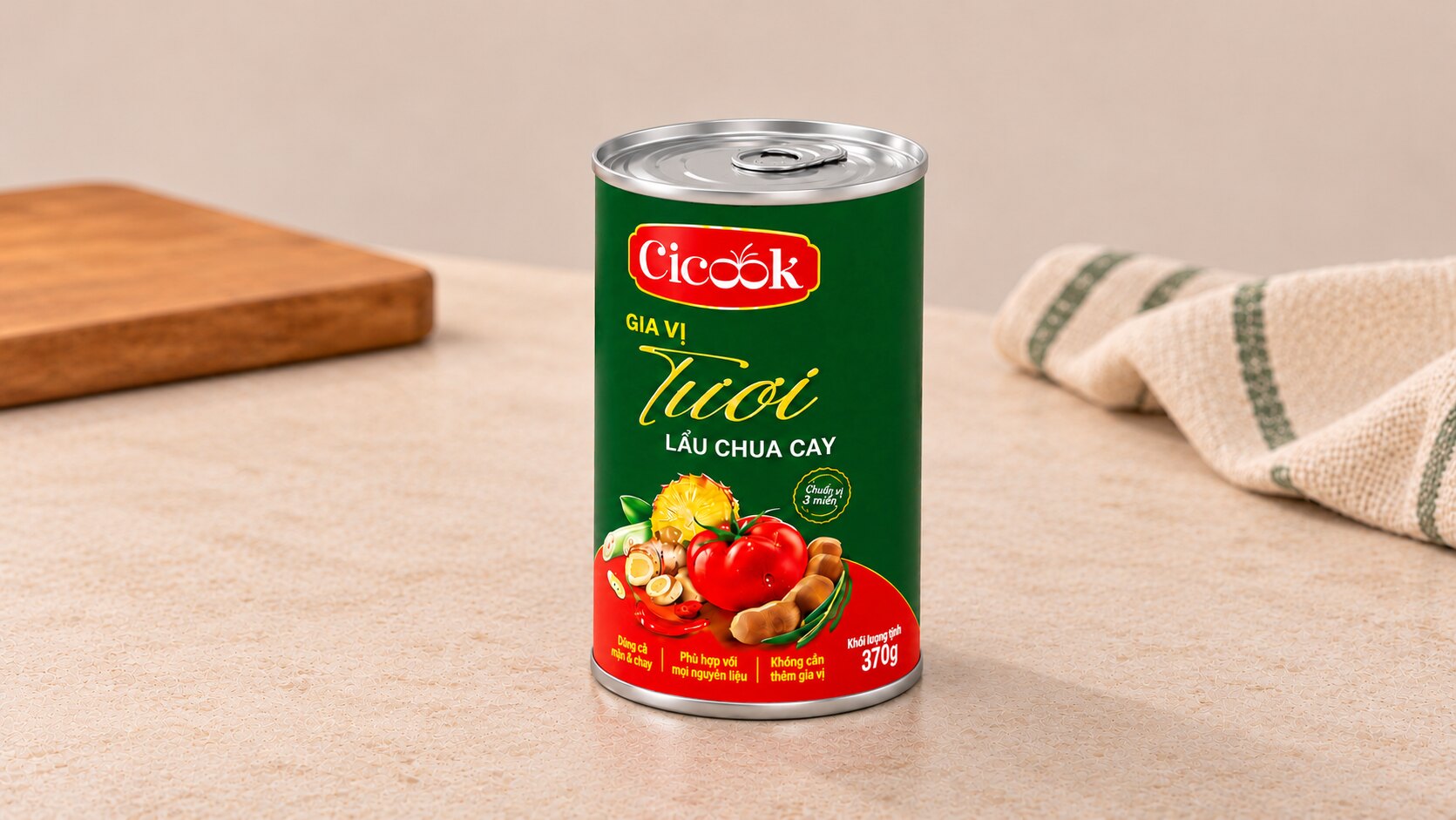
A can of sour and spicy hot pot sauce on a wooden table (Illustrative photo)
4. Challenges for sauce exporters supplying retailer brands
The opportunity is real, but so is the competition. PLMA's press release of 3 November 2026 says nearly 1,900 suppliers from about 60 countries will fill more than 3,000 booths at its Chicago show, with nearly 50 international pavilions according to the October e-scanner.
- Cost pressure: flat dollar growth means buyers will compare landed cost per unit very closely, including freight and duties.
- Taste is the selling point: since shoppers now cite taste and quality, a cheap but bland sauce is unlikely to win a listing.
- Adapting authentic flavour: a recipe that sells in Vietnam may need milder heat, a different sweetness or a clearer usage idea for US home cooks.
- Consistency across batches: a retailer brand carries the store's name, so any batch-to-batch difference becomes the retailer's problem.
5. How can sauce exporters prepare for retailer-brand buyers?
Start with documents and samples, then a clear story about flavour and use. A practical checklist:
- Prepare a full spec sheet for each sauce: ingredients, allergens, shelf life, storage conditions and pack sizes.
- Have the export paperwork ready, including certificates and batch test reports; our guide to export documents buyers request for Vietnamese sauces lists the usual set.
- Offer a flavour ladder, for example mild, medium and hot versions of one sauce, so the buyer can match the retailer's shopper.
- Quote landed cost scenarios for different pack formats and order sizes instead of a single price.
- Plan trade show meetings early: book appointments before the event and bring samples that match the retailer's category; the approach in our sourcing checklist for sauce trade fairs works for any show.
6. What this means for importers and brands
For US importers and retailers, Asian sauces are one way to add flavour-led items to a store brand range that shoppers now judge on taste. CiCook makes OEM, ODM and private label sauces in a US FDA-registered facility certified to ISO 22000:2018, with a COA for every batch; its range includes Vietnamese dipping sauces, hotpot bases and BBQ marinades.
FAQ
When and where is the PLMA 2026 Private Label Trade Show?
It runs from 15 to 17 November 2026 at the Donald E. Stephens Convention Center in Chicago, according to PLMA's announcement of 3 November 2026.
Do US store brands compete only on price?
No. In FMI's 2026 survey, quality (39%) and taste (37%) were the top reasons shoppers gave for buying more store brands, so flavour and consistency matter as much as price.
Planning a retailer-brand sauce range? Contact CiCook or message WhatsApp/Zalo +84 824 084 408.
References
- PLMA (3 Nov 2026): PLMA's 2026 Private Label Trade Show brings product innovation, expanded education to Chicago
- PLMA e-scanner (10 Oct 2026): store brand sales at the nine-month mark; trending simmer sauces
- PLMA (2026): Store brand facts
- PLMA (20 Jan 2026): U.S. private label industry reached $282.8 billion in sales in 2025
- Food Trade News (16 Jun 2026): FMI: private label continues to gain ground with shoppers