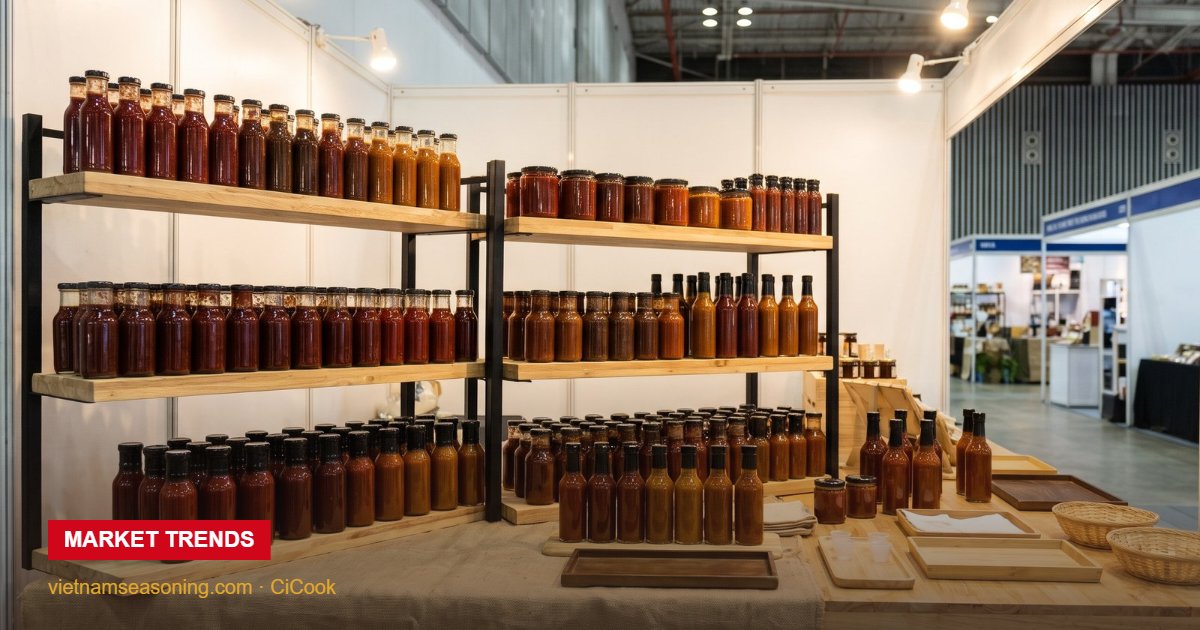
Trade between Vietnam and Japan grew about 15% in nine months of 2026. Here is what the numbers and import rules mean for sauce exporters.
Vietnam-Japan trade reached about US$44 billion in the first nine months of 2026, up about 15% year on year, according to Vietnam's trade office in Japan. Processed food is among Vietnam's export lines to Japan, and trade officials name deeply processed food as a product group with room to grow.

Stacked shipping containers and gantry cranes on a port quay at sunrise (Illustrative photo)
1. How big is Vietnam-Japan trade in 2026?
Bilateral trade is growing faster than in 2025. Viet Nam News reported on 9 November 2026 that trade between the two countries neared US$51.4 billion in 2025, up more than 11%, and reached about US$44 billion in January–September 2026, up about 15%. Japan's cumulative registered investment in Vietnam stands at about US$80 billion, the third largest.
The figures came ahead of the official visit to Japan by General Secretary and President To Lam from 8 to 11 November 2026. Ta Duc Minh, head of the Vietnam Trade Office in Japan, said more Japanese firms are now looking for Vietnamese suppliers, processing partners and quality consumer products, not only production sites.
2. Key figures for food exporters
The table brings together the numbers published in the first two weeks of November 2026 that matter most to sauce and seasoning suppliers.
| Indicator | Figure | Source |
|---|---|---|
| Vietnam-Japan trade, 2025 | Nearly US$51.4 billion, up more than 11% | Viet Nam News, 9/11/2026 |
| Vietnam-Japan trade, 9M 2026 | About US$44 billion, up about 15% | Viet Nam News, 9/11/2026 |
| Vietnam's agro-forestry-fishery exports, 10M 2026 | US$63.02 billion, up 8% | Viet Nam News, 9/11/2026 (Ministry of Agriculture and Environment data) |
| Asia's share of those exports | 49.7%, with exports to Asia up 11.8% | Viet Nam News, 9/11/2026 |
| Food lines Japan buys steadily | Seafood, coffee, vegetables and fruit, frozen food | Viet Nam News, 9/11/2026 |
| Next major food fair in Japan | FOODEX JAPAN 2027, 9–12 March 2027, Tokyo Big Sight | FOODEX JAPAN official site |
2.1 What did the November 2026 visit bring for food trade?
For farm products, the clearest result was on fruit. VietnamPlus reported on 13 November 2026 that Vietnam's agriculture ministry and Yamanashi prefecture agreed to prioritise market-access procedures for Vietnamese pomelos and Japanese grapes for the 2027 crop, with passion fruit and peaches next. No sauce-specific agreement was reported.
2.2 Which Vietnamese food products have room to grow in Japan?
Officials point to processed food. Ta Manh Cuong of the Vietnam Trade Promotion Agency listed deeply processed food, coffee, tea, dried fruit and seafood among the potential items, and named green and organic products, transparent traceability and e-commerce as key Japanese consumer trends.
3. What makes Japan a demanding market for sauces?
Japan checks every food consignment at the border. Under Article 27 of Japan's Food Sanitation Act, importers must file an import notification with the Ministry of Health, Labour and Welfare (MHLW) each time they bring in food for sale, and the product cannot be sold without it.
- Border inspection. MHLW inspects imported food at quarantine stations in 32 international airports and seaports; non-compliant goods can be destroyed or shipped back.
- Published violations. MHLW posts monthly lists of violations found at import notification, which buyers use to judge supplier risk.
- Quality over price. Vietnamese trade officials say goods are moving away from price competition toward deeper processing, brand building and stricter consumer demands.
- No shortcut through trade figures. Fast overall growth does not show demand for any single sauce; buyers still need their own market tests.
4. How should exporters prepare for Japanese buyers?
Start with the importer's compliance file, then the product. A vendor-neutral checklist:
- Confirm who files the import notification. Agree with the Japanese importer which ingredient and process data they need for MHLW, in what format and how early.
- Use MHLW's own checklist. MHLW publishes Guidelines on Hygiene Control of Import Processed Foods with a checklist; compare it with your HACCP plan before the first order.
- Review recent violations. Read the latest monthly MHLW violation lists for sauces, seasonings and their ingredients and address similar risks in your specification.
- Prepare the document set early. Keep COA, origin and test reports in one file, as in our guide to export documents for Vietnamese sauces.
- Plan for FOODEX 2027. Visitor registration opens on 2 December 2026; use the fair to test samples with importers, much like the approach in our Vietnam Foodexpo 2026 sourcing checklist.
5. What this means for importers and brands
For Japanese importers and private-label brands, the trend favours suppliers that can document safety and traceability for processed products such as Vietnamese hot pot sauces, not only sell on price. CiCook runs an FDA-registered, ISO 22000:2018 and HACCP-certified operation, issues a COA for every batch and makes OEM, ODM and private-label sauces in jars, bottles, pouches, sachets or bulk.
FAQ
Do importers need to notify Japan for every food shipment?
Yes. Article 27 of the Food Sanitation Act requires an import notification to MHLW on each occasion that food is imported for sale or business use.
When is FOODEX JAPAN 2027?
FOODEX JAPAN 2027 runs from 9 to 12 March 2027 at Tokyo Big Sight. Visitor pre-registration opens on 2 December 2026.
Exploring sauces for the Japanese market? Contact CiCook or message WhatsApp +84 813 378 398.
References
- Viet Nam News (9/11/2026): Việt Nam-Japan trade machine has room to run
- VietnamPlus (13/11/2026): Vietnam, Japan fortify cooperation in environment, agriculture, marine economy
- Viet Nam News (9/11/2026): Growth holds in agro-forestry-fishery exports during ten months
- MHLW Japan (accessed 13/11/2026): Imported food safety and import procedure under the Food Sanitation Act
- FOODEX JAPAN 2027 (accessed 13/11/2026): Show dates and visitor registration